Visitors’ medicine bags: include them in the home’s storage conversation
A home may have a careful medicine-storage routine while a visitor’s handbag or overnight case sits elsewhere. Include those temporary belongings in the conversation before a baby’s growing mobility makes the gap more visible. The task is safe storage and adult coordination, with no medication dosing, treatment or assumption that a sealed bag removes the need to think about access.
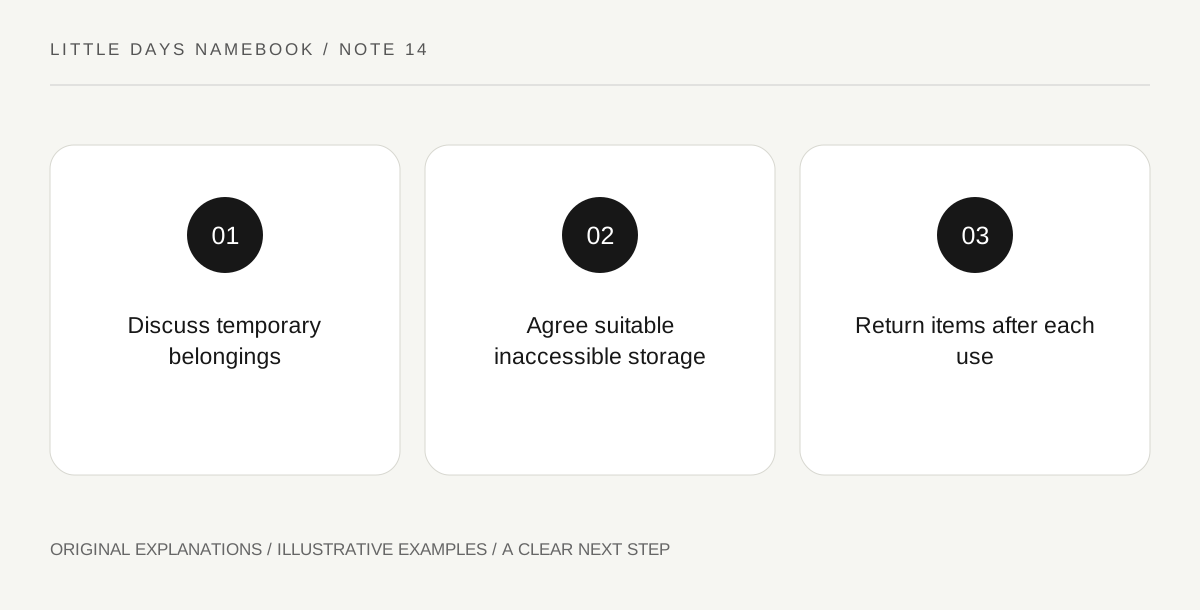
Original explanatory diagram. Read the full method and limitations below.
Include medicines adults bring with them
CDC’s Up and Away guidance advises keeping medicines, vitamins and supplements out of children’s sight and reach and putting them away after use. Apply that storage principle to visiting adults as well as the household’s own supplies. A guest may need regular access to medication, so discuss a suitable arrangement respectfully rather than asking them to leave necessary treatment behind. The practical question is where the items can be kept according to their instructions while remaining inaccessible to children.
Ask before choosing a storage place
Tell guests the household’s storage expectation and ask what they need for their items, including any product-specific condition that the responsible professional has given them. Do not transfer medicines into an unlabeled container for the sake of a tidy room. A handbag, coat pocket or overnight case should not be assumed to solve the access question merely because it is usually closed. If the home cannot provide a suitable arrangement, discuss another visit format rather than improvising storage that conflicts with the actual product or care instructions.
Make after-use storage part of the routine
The arrangement needs to work each time an adult takes out an item. Keep the responsible adult clear and avoid leaving medicine beside a chair or bed for later convenience. Do not make a child responsible for reminding visitors or handling their medicines. This article does not determine whether a product is suitable for the baby, how it should be taken or what treatment anyone needs. Its role is to close a household-access gap that can arise when ordinary adult belongings are treated as separate from the home’s safety routine.
Use an immediate professional route for an exposure concern
If you suspect a child may have accessed medicine, seek urgent advice through the appropriate local poison or emergency service rather than waiting for symptoms or using a household checklist to assess the risk. Keep the actual product information available for professionals as directed. Do not induce a response or attempt an improvised treatment from this article. For planning, finish with a clear storage conversation and responsible adult. Prevention and emergency assessment are different tasks, and the latter belongs with qualified services when a concern arises.
Illustrative family example
Illustrative visit: an overnight guest carries necessary medication in a handbag. The host raises the home’s storage arrangement privately and asks about the product’s actual conditions. They agree on a suitable inaccessible location and on returning items after each use. The bag is no longer left beside a low chair, and neither adult treats its zipper as a complete answer to child access.
Questions that come up
Does a closed handbag automatically provide appropriate medicine storage?
Do not assume so. CDC’s storage principle concerns being out of children’s sight and reach, including after use; the actual household arrangement still needs attention.
Does this guide say how to treat a possible ingestion?
No. A suspected exposure needs prompt local poison or emergency professional advice. The article supplies no treatment or dosing instructions.
References and scope
These sources support the factual background. Examples and exercises are original illustrative teaching material. References do not imply endorsement.
- CDC: Up and Away Campaign Resources — Keeping medicines, vitamins and supplements out of sight/reach and stored after use; no dosing, diagnosis or treatment instructions.