A smoke-free home and car: make the baby-visit message clear
A household boundary works better when visitors know it before arriving. For a home with a baby, communicate the smoke-free arrangement in plain terms and apply it consistently, including transport. The message can be respectful and firm without turning the doorstep into a debate about whether a window, another room or a brief exception changes the care plan.
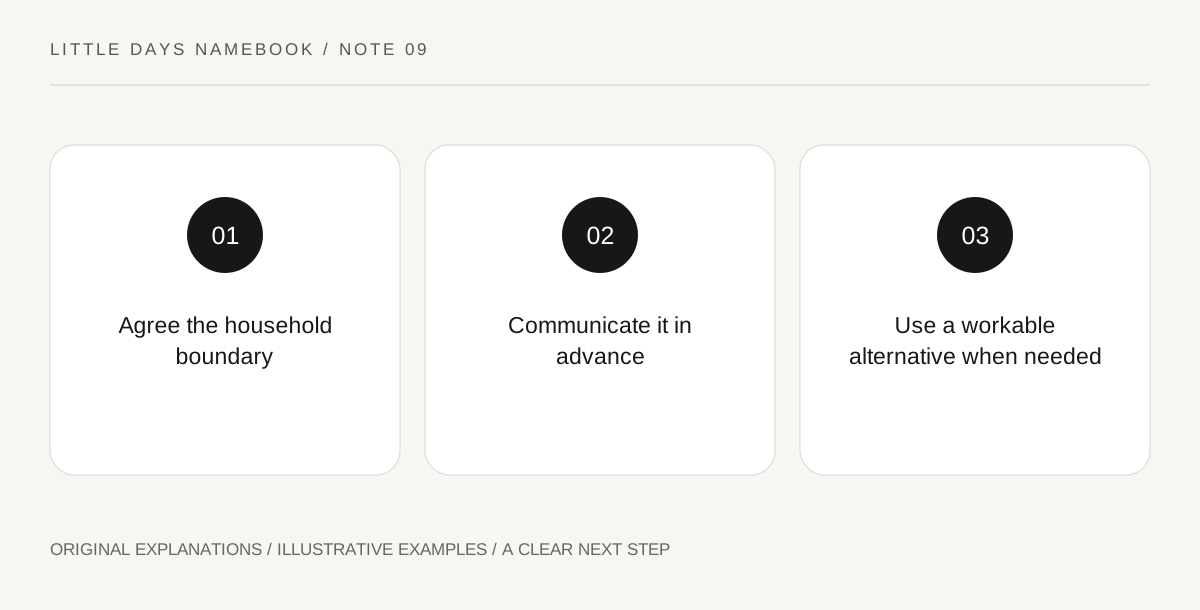
Original explanatory diagram. Read the full method and limitations below.
State the boundary accurately
NHS guidance advises a smoke-free home and car and explains that opening windows or using another room does not protect people from secondhand smoke. Keep that advice as the factual foundation, without adding invented distances or a home-made decontamination ritual. Tell visitors that smoking is not permitted in the home or family vehicle. The boundary concerns the baby’s environment, not a judgment about whether a relative is welcome as a person. A short clear message reduces the chance that a visitor mistakes politeness for an unspoken exception.
Send the practical information before the visit
Use the same message for relatives, friends and anyone offering transport. Ask them to tell you in advance if the arrangement cannot work for them so another plan can be made. Do not rely on one parent to enforce a rule the other has quietly described as optional. The adults responsible for the baby should agree on the wording and who will explain it. Consistency matters because a household boundary becomes confusing when visitors receive different instructions from different people.
Avoid negotiating through improvised compromises
If someone proposes smoking in a spare room, at an open window or in the car before a ride, return to the stated smoke-free arrangement rather than evaluating a new exception on the spot. Ask the baby’s clinician for individualized questions, and use appropriate stop-smoking support if wanted. This article does not prescribe cessation medication or provide a complete exposure assessment. Its practical role is helping adults communicate and uphold a clear environmental boundary that follows the cited public-health guidance.
Keep the relationship open without changing the rule
Offer a different meeting or transport arrangement if that helps the visitor respect the boundary. A postponed visit is an option when the practical conditions cannot be met. Avoid asking a sibling to police adults or making the baby’s needs a subject of a family vote. After the visit, adjust the clarity of the message if there was confusion, rather than inventing a blame narrative. The outcome is a household routine that people can understand before they arrive and responsible adults can maintain without a repeated argument.
Illustrative family example
Illustrative message: parents tell invited adults that the home and family car are smoke-free and ask them to discuss transport concerns before arrival. A relative suggests using a spare room; the parents repeat the same boundary and arrange another visit format. Both adults use the same wording. The family does not invent a washing ritual or a window-opening exception as a substitute for the stated environment.
Questions that come up
Does opening a window make indoor smoking an equivalent arrangement?
NHS guidance says that opening windows or smoking in another room does not protect people from secondhand smoke. Keep the household environment smoke-free.
Does this guide prescribe how someone should stop smoking?
No. It concerns visitor communication. Appropriate clinical or stop-smoking services can discuss cessation support for the individual.
References and scope
These sources support the factual background. Examples and exercises are original illustrative teaching material. References do not imply endorsement.
- NHS: Passive smoking — Smoke-free home/car advice and the limits of windows or separate rooms; no cessation treatment or invented exposure procedure.