A first library baby session: read the service details before the activity description
Books and songs may be the appealing part of a library baby session, while registration, access and caregiver participation determine whether the outing works. Read those service details first. A manageable first visit can be brief and ordinary, without requiring a baby to sit through the whole program or making one reaction a verdict on whether the family belongs there.
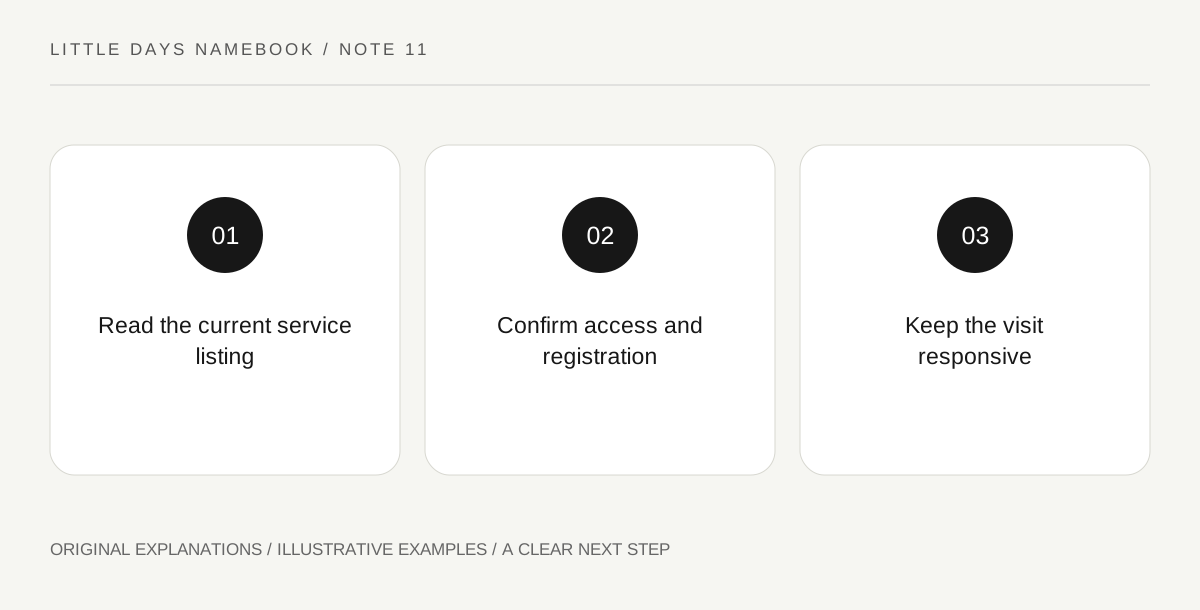
Original explanatory diagram. Read the full method and limitations below.
Treat a listing as a dated service record
A New York Public Library baby-storytime listing provides a concrete example of age guidance, registration and building-access details. It is a past dated example, not a promise of a current session. For your own outing, find the current provider listing and check the actual date, location and intended audience. A program title alone does not establish that every branch offers the same arrangement. Keep the service information with the outing note rather than relying on a photograph of children enjoying a different event.
Clarify participation and practical access
Ask whether an adult remains with the baby, what registration covers and how the actual room is reached. Check relevant access needs with the provider rather than assuming the main building entrance describes every internal room. If stroller arrangements or another practical detail matters, ask directly. Do not buy equipment merely because an old listing mentions an option; use the current service information and the baby’s appropriate care arrangement. A brief inquiry can reveal whether another session or venue would make the first outing simpler.
Keep the first visit flexible
Choose a plan that allows you to respond to the baby’s ordinary needs and the provider’s room guidance. There is no need to make attendance an endurance task or a social comparison with other families. If the baby needs a break, use the arrangement agreed with the staff rather than forcing completion for the sake of a photograph. A quiet visit or an early departure can still provide useful information about the space and service. The purpose is an accessible shared outing, not proof of advanced interest in books.
Record one useful service discovery
Afterward, note a practical detail that will help another visit: the actual room, registration route or a question answered by staff. Keep observations about the baby modest and specific rather than predicting future reading ability from one session. If you share an image, obtain the appropriate permissions and avoid including other children by default. The best result may simply be that you know how the service works and whether the current format suits your family. That is enough reason to try a community activity without turning it into a performance.
Illustrative family example
Illustrative outing: a caregiver checks a current library listing, confirms the room’s access arrangement and completes the actual registration. During the session the baby needs a break, so they follow the staff’s guidance and leave earlier than planned. The outing note records the room and booking process. It does not conclude that the baby dislikes books or that another family’s longer attendance was more successful.
Questions that come up
Does registration for one branch cover another branch’s session?
Do not assume that. Use the actual provider and event process, particularly where capacity or participant details are specified.
Is leaving early evidence that the activity failed?
No. A first outing can teach you about the service and setting. Responding to the baby’s needs matters more than completing an arbitrary duration.
References and scope
These sources support the factual background. Examples and exercises are original illustrative teaching material. References do not imply endorsement.
- New York Public Library: Baby Storytime, dated May 18, 2026 example — A dated example showing registration, caregiver/age and room-access information; no current session recommendation.