A pet and a new baby: assign adult roles before the first shared moment
A calm-looking pet and a sleeping newborn do not remove the need for deliberate adult supervision. Before a shared moment, decide who is attending to the baby and who is responsible for the animal. Keep the interaction optional and follow individualized professional advice, rather than staging a photograph that asks either the baby or pet to tolerate more than the situation supports.
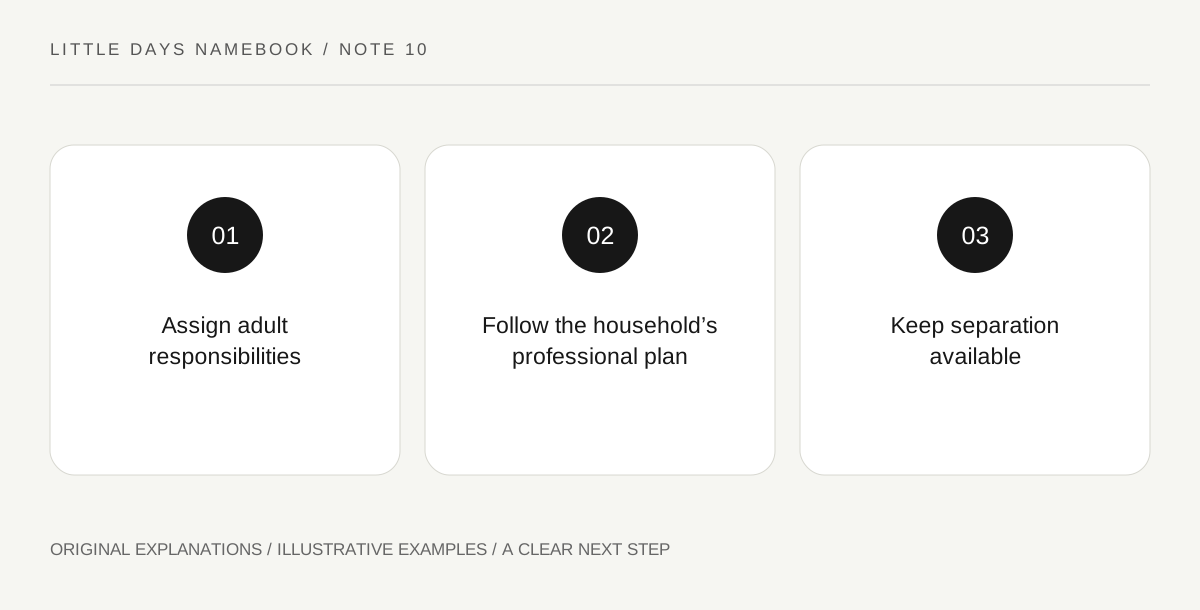
Original explanatory diagram. Read the full method and limitations below.
Begin with supervision, not a prediction
American Academy of Pediatrics guidance says not to leave a dog or cat unsupervised near a new baby. Use that clear principle without claiming that a familiar animal is safe because it has always been gentle with adults. Describe any actual concerns to the baby’s clinician and an appropriate veterinary or qualified behavior professional. This article does not assess an animal remotely or provide a behavior-training protocol. Its narrow purpose is to make the adults’ responsibilities explicit before the baby and pet share space.
Give the two attention tasks separate owners
Name the adult attending to the baby and the adult managing the pet under its appropriate handling plan. If one person cannot manage both responsibilities safely, use a separate arrangement instead of forcing an interaction. Do not give a child the job of controlling an animal around the newborn. The plan should work without everyone trying to watch a phone screen at once. A first shared moment does not need an audience, a countdown or proof that the household has achieved instant harmony.
Keep the interaction voluntary and stoppable
Use the professional guidance appropriate to the actual animal and household, and stop the shared moment when the arrangement is not working. Do not bring the baby closer to create a better photograph or interpret stillness as consent. Avoid online challenges that prescribe a universal greeting sequence. A pet’s reaction can depend on circumstances that a short article cannot evaluate. The practical question is whether responsible adults can maintain the agreed supervision and separation whenever needed, not whether one successful minute proves every future interaction will be predictable.
Plan ordinary life after the introduction
Discuss doors, sleeping areas and caregiving routines with the relevant professionals and adults so supervision does not depend on a one-time ceremony. Keep any specific advice attached to the household it concerns. Revisit the arrangement as the baby’s abilities and the animal’s circumstances change, rather than treating the first meeting as permanent clearance. A useful record names the adult roles, the professional contact for questions and the separate option when attention is limited. It can support a more manageable home without pretending to eliminate every risk through one choreographed introduction.
Illustrative family example
Illustrative arrangement: two adults decide that one will attend to the baby and the other to the dog under their professional advice. They decline a requested close-up photograph and keep a separate-space option ready. A later change in routine prompts another discussion rather than reliance on the first calm encounter. The record concerns supervision and responsibility, not a claim that the animal has passed a permanent safety test.
Questions that come up
Does one calm meeting prove every future interaction is safe?
No. The circumstances and participants can change. Continue the required supervision and revisit household-specific questions with appropriate professionals.
Must the first shared moment produce a photograph?
No. Documentation is optional. The baby’s care and responsible animal management take priority over a staged image or an audience’s expectations.
References and scope
These sources support the factual background. Examples and exercises are original illustrative teaching material. References do not imply endorsement.
- AAP: Bringing Baby Home — Preparing Yourself, Your Home and Your Family — The supervision principle for dogs/cats near a new baby; no remote animal assessment or behavior-training sequence.