A pool gathering with a baby: name the supervising adult before the party starts
A gathering near water creates a different attention task from an ordinary visit, even when the baby is not expected to swim. Decide who is responsible for close supervision and how adults will coordinate without assuming that a group, a lifeguard or a previous water class makes the responsibility disappear. Keep individual participation questions with the baby’s clinician and appropriate provider.
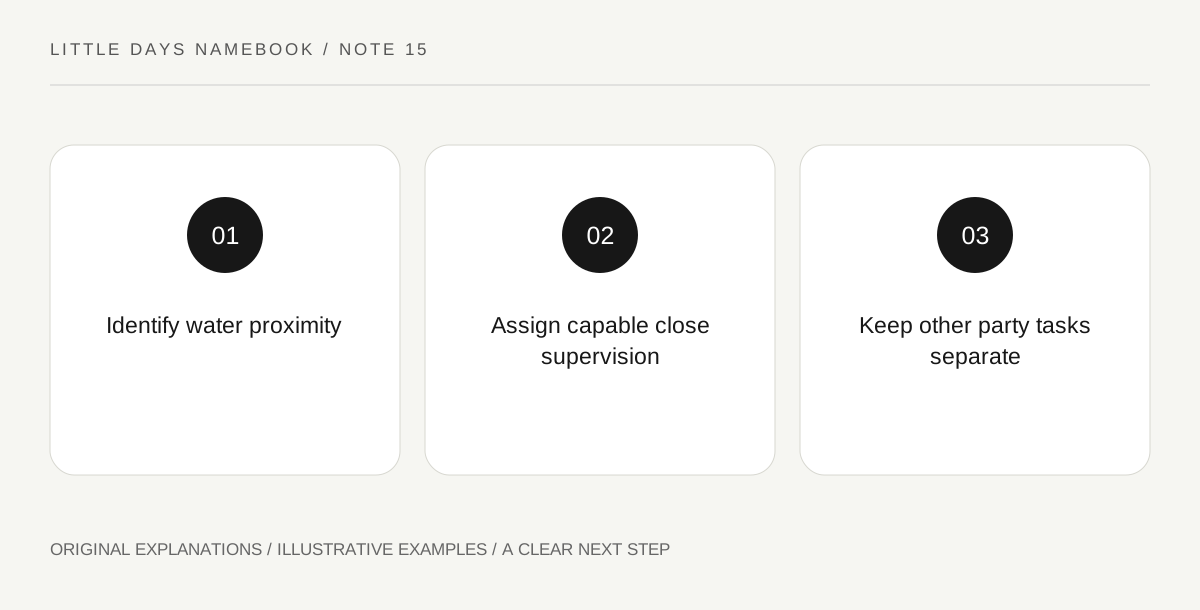
Original explanatory diagram. Read the full method and limitations below.
Start with the current supervision principle
AAP’s updated drowning-prevention guidance calls for close, constant, attentive and capable adult supervision. For infants and toddlers in or around water it describes touch supervision within arm’s reach by an adult with swimming skills. Use that principle as the foundation, not a claim that the whole party can watch collectively. A baby’s presence near a pool is already relevant to the plan. Do not wait until someone decides to enter the water before establishing who is responsible.
Give supervision one clear owner
Name the responsible capable adult and make sure they understand the role, with an agreed direct transfer when another adult takes over. Do not assume that a casual statement such as everyone is watching creates a reliable arrangement. The supervising adult’s attention should not be divided among phone use, photography or serving guests. A helper can take those other tasks. If the necessary supervision cannot be maintained, move the baby and responsible caregiver to an appropriate setting away from the water rather than trying to compensate with a group promise.
Keep lessons and devices in their proper role
AAP states that lessons do not make a child drown-proof and that there is no evidence infant lessons reduce drowning incidence. Do not use a class completion, float photograph or device as a reason to relax the supervision requirement. This article does not teach swimming, rescue or emergency technique. Ask the pediatrician and a suitable program about any individual water-participation question. The party plan’s immediate task is maintaining appropriate adult attention and access boundaries, not testing what a baby can do in water.
Make the gathering compatible with the role
Choose seating and activities so the responsible adult can maintain the actual required supervision rather than relying on a distant visual check. Let another guest handle a phone or a conversation that would distract them. If the plan changes, explicitly transfer responsibility before the supervising adult leaves, or take the child with them as appropriate. Finish the invitation planning by identifying the role and a workable alternative. A successful gathering can include no baby swimming at all; participation is not owed to the host or camera.
Illustrative family example
Illustrative party: a family attends a gathering with a pool but has not planned infant swimming. The adults still discuss water proximity and name the responsible capable supervisor. Another guest handles photographs and refreshments. When attention would be divided, the baby leaves the water-side setting with the caregiver. No one treats a group of nearby adults or an earlier class as a substitute for the required close supervision.
Questions that come up
Does having several adults nearby remove the need for an assigned supervisor?
No. The role needs clear responsibility and appropriate close attention. A group assumption can leave everyone believing someone else is doing it.
Does this article authorize a baby’s participation in a water class?
No. Individual participation needs appropriate clinician and provider guidance. This article concerns supervision and gathering coordination, not swimming or rescue instruction.
References and scope
These sources support the factual background. Examples and exercises are original illustrative teaching material. References do not imply endorsement.
- AAP: Updated Drowning Prevention Recommendations, 2026 — Current close/touch-supervision principles and limits of infant lessons; no water technique or participation clearance.