A tiny name song: make it an invitation rather than a test
A family can invent a gentle little song around a baby’s name without turning it into a language lesson or a demand for a response. Keep the words simple, the interaction comfortable and the performance entirely optional. The useful project is an affectionate adult invitation, with no claim that a particular melody makes a baby recognize a name sooner.
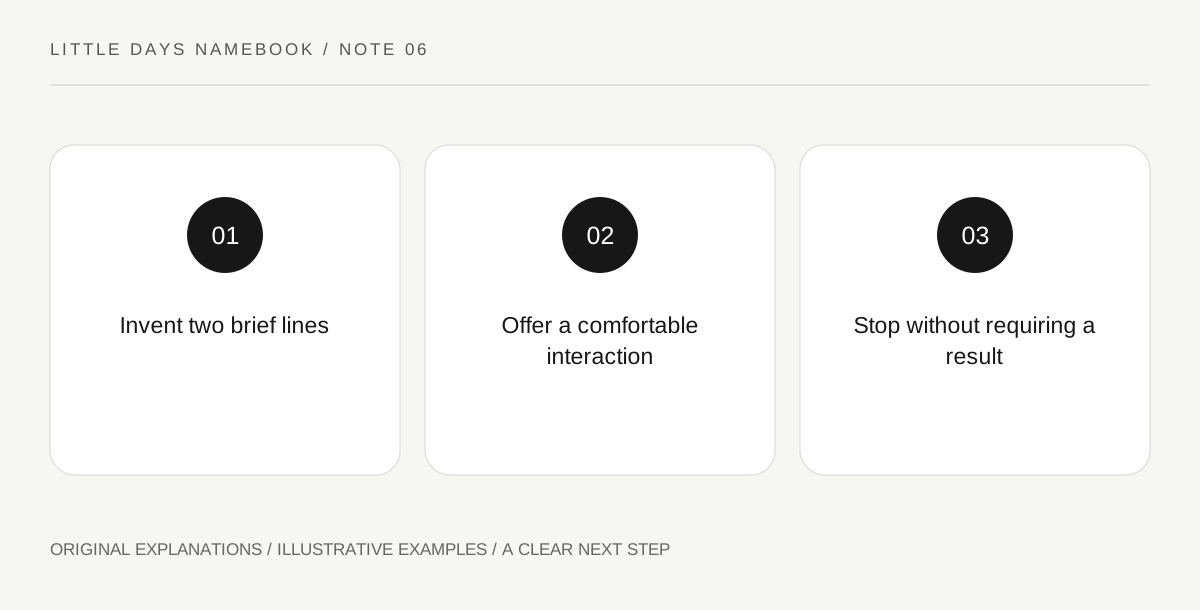
Original explanatory diagram. Read the full method and limitations below.
Begin with ordinary interaction
The American Academy of Pediatrics includes talking and singing among ordinary ways adults interact with babies. That supports a simple family song, not a developmental guarantee for a specific tune. Choose a comfortable awake moment within the baby’s actual care needs and let an attentive adult remain responsive. There is no need for a recording, a special device or a fixed daily target. A name can be part of familiar communication without becoming a task the baby must complete to demonstrate learning.
Write an original two-line invitation
For an illustrative creative exercise, use a fictional name in a short original phrase such as Hello, little Mira; we are here today. Add a second line about an ordinary shared moment in your own words. The phrase is an invented example and supplies no meaning or origin for the name. You can speak it rhythmically or choose an uncomplicated original melody. Avoid borrowing a recognizable song’s lyrics and presenting them as your own work. The family’s voice and attention matter more to the project than a polished composition.
Leave room for no response
Sing or speak briefly and notice whether the baby seems comfortable with the interaction. Do not repeat louder or longer to obtain eye contact, a smile or a recorded reaction. If the moment no longer suits the baby’s needs, stop and attend to ordinary care. A quiet response is not a failed song, and a smile is not proof of a particular developmental milestone. This keeps the activity relational rather than evaluative, which is especially useful when adults are tempted to turn a sweet moment into a performance for relatives.
Let the song change naturally
Different caregivers may use a different rhythm or language they know well, without claiming every version is linguistically identical. Keep any wording you want to remember in a private family note and credit a collaborator’s original contribution. There is no need to preserve one authorized family arrangement forever. As the child grows, they may enjoy changing it or prefer another activity. End with the modest purpose: an affectionate shared invitation. That leaves the child free to respond in their own way instead of carrying a requirement to validate the adults’ creative project.
Illustrative family example
Illustrative moment: a caregiver invents two short lines using a fictional name and speaks them softly during a comfortable awake interaction. The baby does not provide a dramatic response, and the adult moves on without repeating the phrase as a test. The private family note preserves the original words and says that the aim was affection, not evidence of accelerated recognition or a promised developmental result.
Questions that come up
Does a baby need to react to show the song worked?
No. This is a small relational activity, not a test with a required result. Attend to the baby rather than pursuing a particular response.
Does a special tune guarantee earlier name recognition?
No such claim is established here. The project uses ordinary singing as an invitation and makes no developmental timing promise.
References and scope
These sources support the factual background. Examples and exercises are original illustrative teaching material. References do not imply endorsement.
- AAP: Healthy Mental and Emotional Development — Key Building Blocks — Talking and singing as ordinary interaction; all song words and creative exercises are original and carry no milestone promise.