When eight relatives choose twice: read the denominator in a name poll
An informal name poll can produce more selections than respondents when people choose several options. Before describing the result as a percentage of people, identify what was counted. A small fictional example makes the arithmetic clear and shows why a family poll can be interesting without representing a country, generation or future classroom.
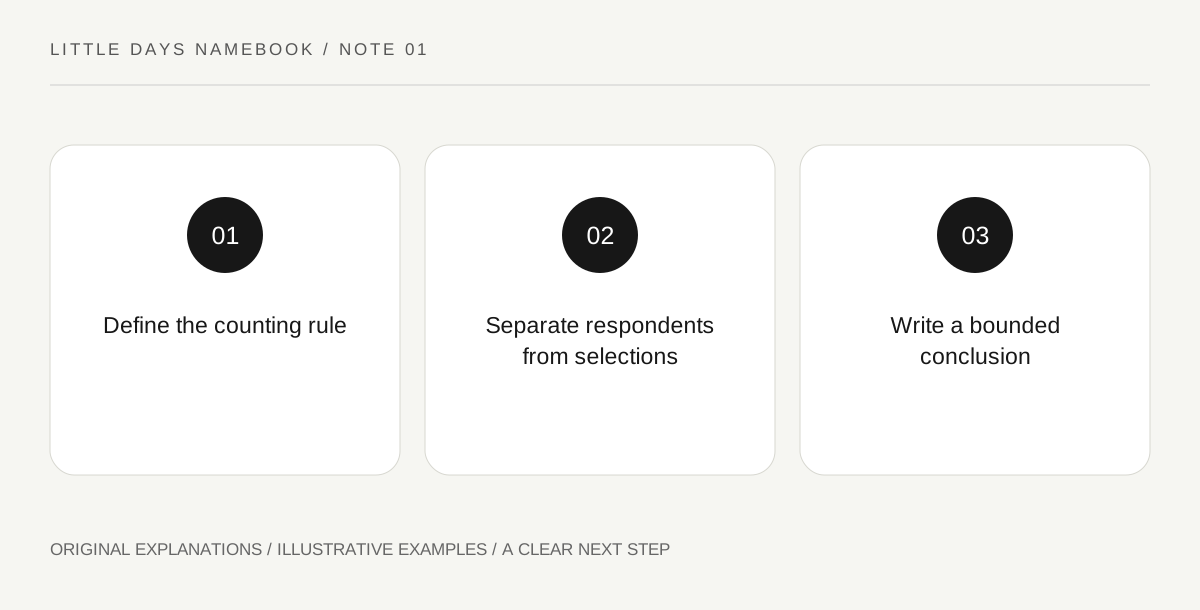
Original explanatory diagram. Read the full method and limitations below.
Write the counting rule
The U.S. Census Bureau treats sample design as a defined part of statistical work. A family poll is much smaller and informal, but it still benefits from an explicit counting rule. Write whether each respondent may select one option, several options or submit a free-text comment. Those formats produce different totals. A list of marks is not automatically a list of people, and a strong-looking percentage becomes misleading if its denominator quietly changes. Preserve the question and rule with the result instead of sharing only a winning bar.
Use one invented arithmetic example
Illustratively, imagine eight relatives each selecting two of four fictional options. There are sixteen selections in total. If option A receives six selections, that is six of sixteen selections, or 37.5 percent of selections. If six different people each selected A once, it is also six of eight respondents, or 75 percent of respondents. Both calculations can be correct while answering different questions. Label the quantity rather than choosing whichever percentage makes the preferred option look more convincing. The numbers here are invented and describe no real naming survey.
Keep comments outside the vote total
A respondent may add an association, a pronunciation question or a factual claim after selecting an option. Store that comment separately instead of counting every sentence as another vote. If one person sends several messages, do not let message volume become respondent count. A simple private table can have one row per willing respondent and separate fields for selections and comments. It need not collect a full identity profile. The purpose is to understand the small exchange accurately, not to build a database of relatives’ personal information.
Do not expand the population
Eight invited relatives remain eight invited relatives. The poll does not establish what all speakers of a language, all children or every employer would think. Its result can reveal a question worth discussing without settling the parents’ decision or predicting the child’s life. Write a bounded conclusion that names the respondents and question in general terms. If the parents keep the result as a memory, retain the counting rule too. That way a playful family activity does not turn over time into an unsupported claim that nearly everyone agreed.
Illustrative family example
Illustrative result card: eight fictional respondents make sixteen selections. A receives six, so the card labels both 37.5 percent of selections and 75 percent of respondents, explaining the difference. A long comment from one person remains a comment, not several votes. The parents treat the exercise as a family exchange and do not call it representative evidence about a wider population.
Questions that come up
Can the percentages of respondents add to more than 100 percent?
Yes, in a multiple-selection format each person can appear under more than one option. State the rule clearly so that readers do not mistake it for a single-choice vote.
Does the largest count decide the name?
The arithmetic describes the responses, not a naming authority. Parents can consider the exchange without delegating the decision or treating it as a forecast of the child’s experience.
References and scope
These sources support the factual background. Examples and exercises are original illustrative teaching material. References do not imply endorsement.
- U.S. Census Bureau: Statistical Quality Standard A3 — Sample design as an explicit methodological component; all family-poll figures and arithmetic examples are original and illustrative.