A private voice keepsake: record the adults’ naming story without staging the baby
A family can preserve the sound of a naming memory without requiring a baby to appear, smile or produce a milestone. Invite willing adults to tell a short story in their own voices, then keep the recording with enough context to understand it later. The project concerns memory and permission, not a pronunciation test or a performance the child must supply.
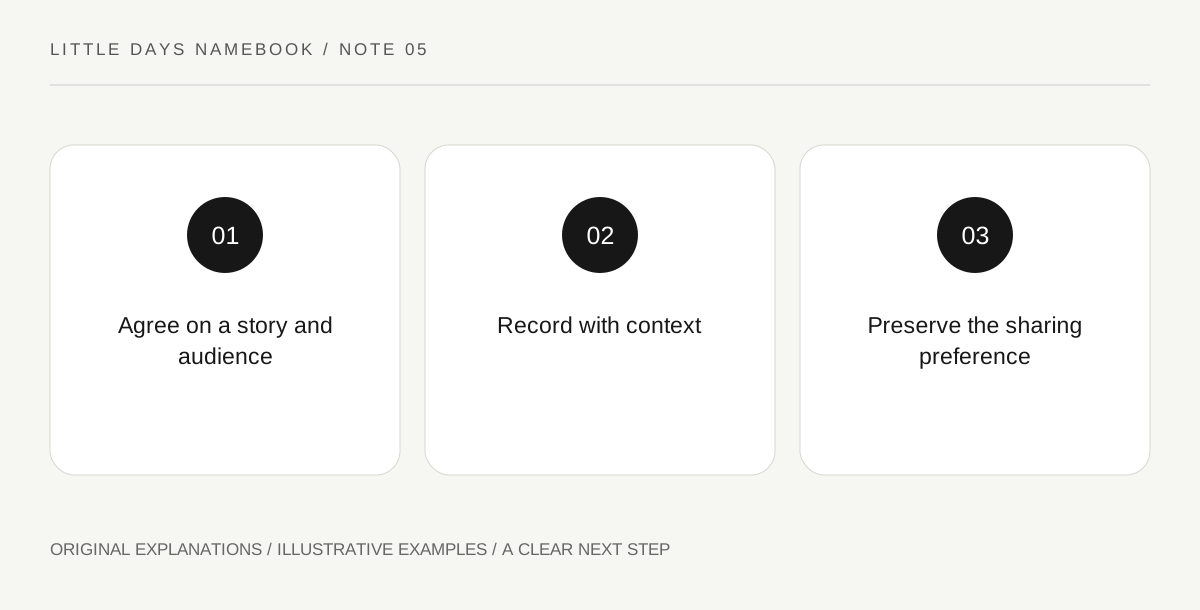
Original explanatory diagram. Read the full method and limitations below.
Choose a story the speaker wants to share
Library of Congress guidance treats audio recordings as materials that need appropriate care and context. For this original family project, begin with a willing adult and a modest prompt: what do you remember about considering the name? Tell the speaker how the recording will be kept and who may hear it. They may decline or choose a less personal memory. A short account can preserve warmth more effectively than a long interview built around questions the person did not expect to answer.
Make an ordinary recording with clear context
Record in a comfortable setting at a suitable volume using the device’s normal functions. The baby does not need to be present. At the beginning or in a separate note, identify the willing speaker, approximate date and purpose, using only the personal detail needed for the private archive. Do not quietly record another person or treat a family visit as consent to publish. The practical aim is a usable memory with an understandable source, not a professional production or a hidden collection of everyone’s opinions.
Preserve uncertainty in the spoken account
A speaker may say they think an idea arose before a holiday, or that another person remembers the sequence differently. Leave those qualifications in place. Do not edit them out to create a cleaner but less honest story. If a name meaning is mentioned without verification, mark it as the speaker’s recollection or belief rather than a dictionary fact. The recording is evidence of what that person said at that time. It does not automatically establish the linguistic history of the name or the exact order of every family conversation.
Keep access and future use explicit
Store the recording in a place the responsible adults understand, with a sensible backup and the speaker’s sharing preference attached. Review access if the family later wants to include it in a public project. Permission for a private keepsake does not silently become permission for every future audience. The child may one day enjoy the voices, question the story or prefer not to share it. End with a short index entry so the file can be found without uploading private family audio simply to make it feel preserved.
Illustrative family example
Illustrative keepsake: a grandparent agrees to record a one-minute memory about hearing the proposed name. The baby is elsewhere with an attentive caregiver and supplies no performance. The recording keeps the grandparent’s uncertain phrasing about the date. A private index names the speaker, recording month and no-public-sharing preference, while an unverified meaning is labeled as recollection rather than established etymology.
Questions that come up
Does the baby need to respond during the recording?
No. The project preserves an adult’s memory. It should not create a demand for a smile, sound or other performance from the child.
Does private recording permission cover a later public video?
Do not assume so. Revisit the proposed audience and obtain appropriate agreement before reusing another person’s voice in a different context.
References and scope
These sources support the factual background. Examples and exercises are original illustrative teaching material. References do not imply endorsement.
- Library of Congress: Care, Handling and Storage of Audio Visual Materials — The care of recorded media; the consent, story prompts and family indexing exercise are original practical guidance.