Welcoming the baby: offer an older sibling a choice of small roles
An older child can be included in a baby’s arrival without being assigned a performance or caregiving responsibility they did not choose. Offer a few small optional roles and keep adult care duties with adults. The welcome can leave room for mixed feelings, ordinary play and attention to the older child’s own life.
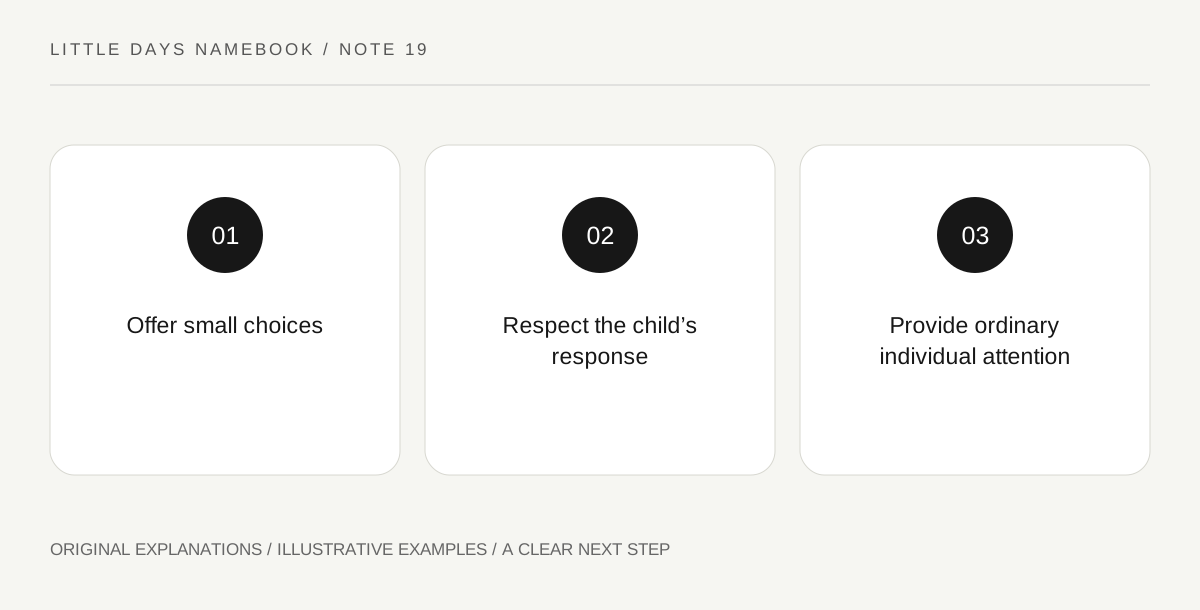
Original explanatory diagram. Read the full method and limitations below.
Begin with the sibling as a person
AAP guidance on a new baby emphasizes preparing older children, offering reassurance and preserving attention to their needs. Use that as the starting point instead of introducing the sibling only as a helper. Ask what they want to know and explain the baby’s actual place in the household in language they can understand. Do not promise an instant playmate or tell them that they must feel delighted. A child can be curious, proud, indifferent or unsettled without owing the adults one correct emotional response.
Offer roles with a real option to decline
For an original welcome exercise, offer choices such as drawing a card, selecting a family story to read with an adult or helping choose between two parent-approved clothing options. Keep the activity appropriate to the child and the setting. Do not assign supervision, feeding or handling on the basis of a decorative role title. A child who declines can do something else with a trusted adult. An invitation is more meaningful when saying no does not lead to disappointment, guilt or a claim that they do not love the baby.
Keep cameras and visitors from directing the moment
Ask guests not to demand a kiss, a holding pose or a delighted reaction for a photograph. Any physical interaction needs the responsible adult’s appropriate supervision and instruction, with the child’s willingness respected. The family can record a card or an ordinary shared moment instead of staging closeness. Do not interpret a brief refusal as evidence of a damaged relationship. A welcome is one event within a changing family life, and the older child should not be asked to provide a reassuring performance for every visitor.
Make room beyond the welcome
Arrange ordinary time with the older child that does not always revolve around baby-related tasks. Ask trusted adults to notice and engage with them during visits. The role choices may change as the family settles, and a favorite small contribution can remain optional rather than becoming a permanent job. End with one practical adult action that supports the sibling’s own needs. Inclusion then becomes a continuing relationship, not a badge earned by smiling in the arrival photograph or proving usefulness to the household.
Illustrative family example
Illustrative welcome: an older child chooses to draw a card and declines a posed photograph. Adults accept both choices and keep baby care with the responsible caregiver. A visiting relative spends ordinary play time with the older child instead of repeatedly asking how much they love the baby. The card becomes a welcome contribution without being used as proof of a required feeling.
Questions that come up
Does declining a welcome activity prove the sibling rejects the baby?
No. One choice in one moment does not establish the relationship. Respect the child’s response and support their ordinary needs.
Should helping become the older child’s main identity?
No. They remain a child with their own interests and needs. Optional participation can support inclusion without making usefulness the condition for attention.
References and scope
These sources support the factual background. Examples and exercises are original illustrative teaching material. References do not imply endorsement.
- AAP: Preparing Your Older Child for a New Baby — Sibling preparation, reassurance and continued individual attention; all role-choice examples are original, not handling instruction.