A first-year journal: label observation, memory and hope differently
A family journal can preserve an ordinary moment without turning every page into a milestone report or a polished origin story. Use three labels: what you observed, what you remember later and what you hoped at the time. The distinction makes the record more honest and leaves the child room to understand their early life without being defined by the adults’ interpretations.
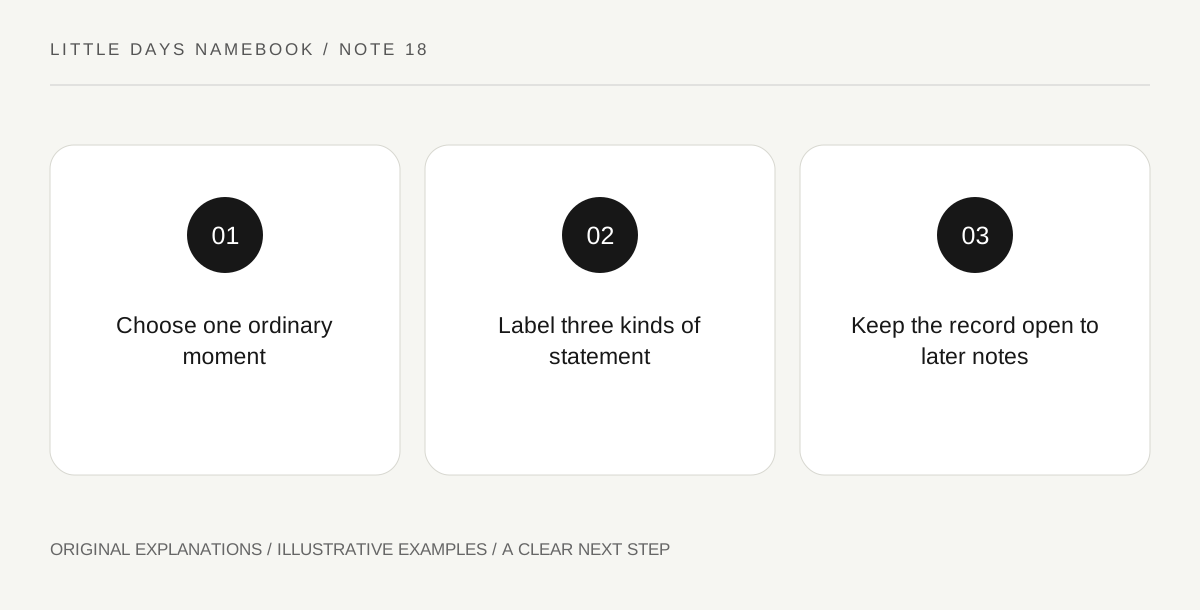
Original explanatory diagram. Read the full method and limitations below.
Choose one modest entry
The Smithsonian’s oral-history guidance values stories as expressions of experience while recognizing that remembered accounts are not automatically exact historical facts. Use that distinction for a private first-year journal. An entry can concern an ordinary walk, a conversation about the baby’s name or a family meal. It does not need to document a new skill. Write enough context to understand the moment later and avoid claiming firsthand observation of something another person told you. A modest accurate entry is more useful than a complete-looking page assembled from guesses.
Use three separate sentences
Begin with an observation sentence describing what you actually noticed. Add a later-memory sentence only if you are writing retrospectively, making uncertainty explicit. A final hope sentence can record what the adult wished without pretending it predicts the child’s future. For example, an adult might remember enjoying a quiet outing and hope for many shared walks. That is different from deciding that the baby’s calmness proves a lifelong personality. The labels let affection remain present while separating it from claims the moment cannot support.
Keep dates honest and medical records separate
Use an exact date when you know it and approximate wording when you do not. Do not silently turn a photo upload date into the date of the pictured event. If a care concern belongs in the clinician’s record, use the appropriate professional route rather than relying on a decorative journal. The memory project is not a developmental screening tool, a health log or evidence that a problem can be dismissed. Its purpose is preserving family experience in a form that clearly shows what kind of statement each sentence makes.
Leave space for future perspective
Keep private details and other people’s stories within the audience they agreed to, and revisit sharing choices as the child grows. A journal can include gaps without being a failed project. Add a later correction as a dated note instead of rewriting an earlier recollection as though it was always certain. The child may enjoy some entries and question others. That possibility makes careful labeling more valuable, not less: the record can become a conversation across time rather than a finished account the child is expected to accept without a voice.
Illustrative family example
Illustrative entry: an adult writes that they observed a brief quiet family walk, remembers it as happening in early spring and hoped it would become a familiar routine. A photograph confirms the month but not the exact day, so the date stays approximate. The entry does not call the baby a naturally outdoors-loving person or treat one calm afternoon as a developmental conclusion.
Questions that come up
Do gaps mean the journal is incomplete in a harmful way?
No. A selected memory project does not need to capture every day. Honest small entries are preferable to invented continuity.
Can one remembered behavior establish the child’s personality?
That is more than the observation supports. Describe the particular moment and label the adult’s interpretation as such rather than making it a permanent identity.
References and scope
These sources support the factual background. Examples and exercises are original illustrative teaching material. References do not imply endorsement.
- Smithsonian Folklife and Oral History Interviewing Guide: The Interview — The value and limits of remembered stories; original family-journal format, not a medical or developmental record.