A baby photo album: review the recipients as carefully as the pictures
A private album can gradually acquire a larger audience than its creators remember. Review who can see, contribute and reshare before adding another month of baby pictures. The exercise is about actual sharing choices and permissions, with no claim that one platform setting makes every future copy controllable.
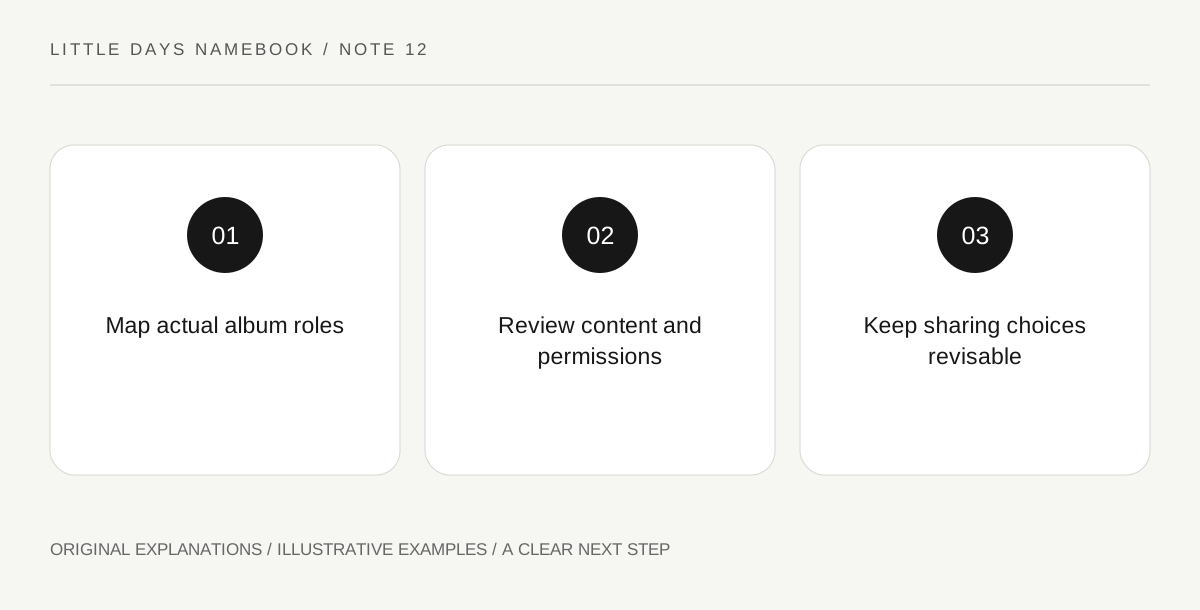
Original explanatory diagram. Read the full method and limitations below.
List the roles in the album
The eSafety Commissioner explains that children’s images can travel beyond the intended audience, including from private messaging. Use that principle to separate viewer, contributor and administrator roles in a family album. They are not automatically the same permission. Write who is meant to occupy each role and compare it with the service’s actual current settings. Do not rely on the reassuring word family in an album title. The practical question is which accounts can do what now.
Review a small sample before adding more
Choose a few existing images and inspect both content and audience. Look for private paperwork, location clues or other people’s children as well as the baby’s face. If an image no longer suits the intended sharing purpose, use the service’s actual options to change or remove it and communicate with recipients where needed. Do not promise that deleting from the album retrieves every saved copy. The review can still reduce unnecessary ongoing exposure without pretending that a retrospective edit gives complete control over earlier sharing.
Agree on contributions and resharing
Tell relatives whether they may add images and whether reposting outside the album is wanted. Keep the request specific and ask before including another family’s child. If one adult does not want to participate, make another arrangement instead of treating a shared album as a requirement of family involvement. A direct message or an occasional printed picture may suit some recipients better. The aim is an understood sharing practice, not making every relative adopt one application or interpreting a privacy preference as a rejection of affection.
Create a small review habit
Revisit the recipient list when accounts, relationships or the album’s purpose change. You do not need an elaborate surveillance routine or a public report of every adjustment. Keep the responsible adult’s contact route clear so someone can raise a concern about an image. As the child becomes able to express preferences, include them in age-appropriate decisions about their own pictures. A family album can preserve meaningful moments while remaining revisable, with the child’s developing perspective treated as part of the project rather than an obstacle to it.
Illustrative family example
Illustrative review: parents discover that a baby album allows more contributors than they remembered. They compare actual roles with their intended audience, discuss a clear resharing preference and remove one image containing another child without agreed permission. They acknowledge that earlier recipients may hold copies. A simple future contact route makes it easier for a relative or the growing child to request a change.
Questions that come up
Does an album called private guarantee that recipients cannot copy images?
No. Choose content and recipients with the possibility of copying or resharing in mind, and communicate your preference clearly.
Must every relative join the same service?
No. A different sharing method can preserve the relationship while respecting access or privacy preferences. The album is a tool, not a family-membership test.
References and scope
These sources support the factual background. Examples and exercises are original illustrative teaching material. References do not imply endorsement.
- eSafety Commissioner: Privacy and your child — Audience, identifying-information and onward-sharing considerations; no platform-specific privacy or deletion guarantee.