Different words for the same baby item: make a shared reference card
Caregivers who use different languages may be referring to the same ordinary item with different words, or using one broad word for several products. A small visual reference card can reduce practical confusion while respecting each person’s language. Keep it separate from clinical translation and product instructions, which require their own appropriate sources.
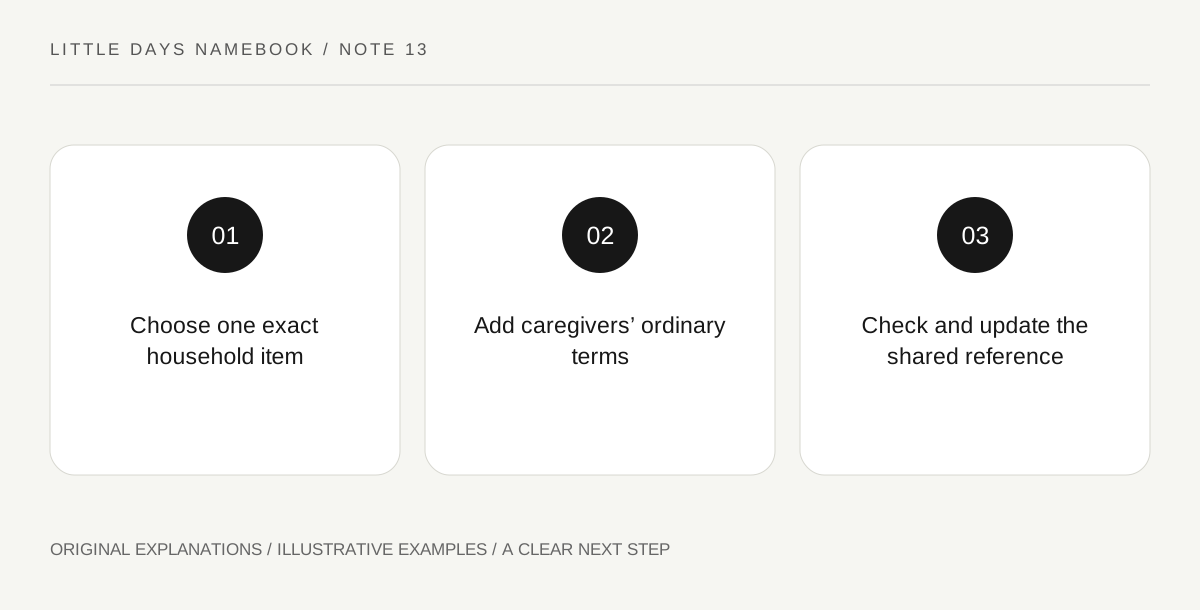
Original explanatory diagram. Read the full method and limitations below.
Let each caregiver supply their ordinary term
AAP and ASHA guidance recognizes that caregivers may use the languages in which they communicate comfortably. For this original household exercise, ask willing caregivers what they call an ordinary non-medical baby item. Write each term beside a clear picture or drawing of that exact item. Do not declare one person’s familiar word incorrect because it differs from another language’s label. The card links language with a shared reference; it is not a test of the baby’s vocabulary or the adults’ cultural competence.
Use exact objects rather than category assumptions
Start with a few harmless organizational items such as a particular storage basket or clothing bag. If a broad word covers more than one object, add a distinguishing feature or location. A picture of one item should not silently authorize substitution with another product. Keep medicines, feeding instructions and other clinical matters outside this informal glossary. Those require the actual care team, product information or qualified interpretation as appropriate. The card’s scope should remain small enough that everyone understands what it can and cannot clarify.
Check understanding in both directions
Ask a caregiver to identify the item from the card, then ask another to point to the matching card from the actual object. If the link is unclear, improve the image or wording rather than adding a judgment about language ability. This two-way check is an ordinary communication exercise, not a certification of translation accuracy. A private household card can be revised easily when a basket moves or a different bag replaces the old one. The shared reference matters more than producing an elegant bilingual poster.
Preserve the appropriate instruction source
If a card is attached near equipment, make sure it does not cover labels or replace the manufacturer’s directions. Do not attach it in a way that interferes with safe use. Use a separate adult reference area if that is clearer. End with a note saying that the card identifies the household item only. The arrangement can make everyday coordination easier while leaving each caregiver’s language intact and keeping technical or clinical instructions with the people and documents responsible for them.
Illustrative family example
Illustrative card: two caregivers use different words for a clothing bag. They add both terms beside a simple drawing and the bag’s current location. A broad word that also describes a storage basket receives an extra distinguishing phrase. Medicines and care instructions are excluded. The card is updated when the bag changes, without claiming that the household exercise provides professional translation or product-use authorization.
Questions that come up
Does a shared item card mean the family should use only one language?
No. The exercise respects different ordinary terms and creates a common reference where practical confusion exists.
Can the card replace translated medical instructions?
No. It is deliberately limited to ordinary household identification. Clinical communication needs an appropriate care-team and interpretation process.
References and scope
These sources support the factual background. Examples and exercises are original illustrative teaching material. References do not imply endorsement.
- AAP and ASHA: Young Children Learning Multiple Languages — Parent FAQs — The legitimacy of caregivers using comfortable languages; all item-card procedures are original and contain no developmental or translation guarantee.