A baby’s appointment: request language support before the conversation begins
Understanding a baby’s care discussion is different from managing an ordinary conversation at a reception desk. If language support would help, ask the clinic how to arrange it before the appointment. A useful request states the caregiver’s communication needs and confirms the service, without assuming a relative, child or translation app can automatically fill a professional interpreting role.
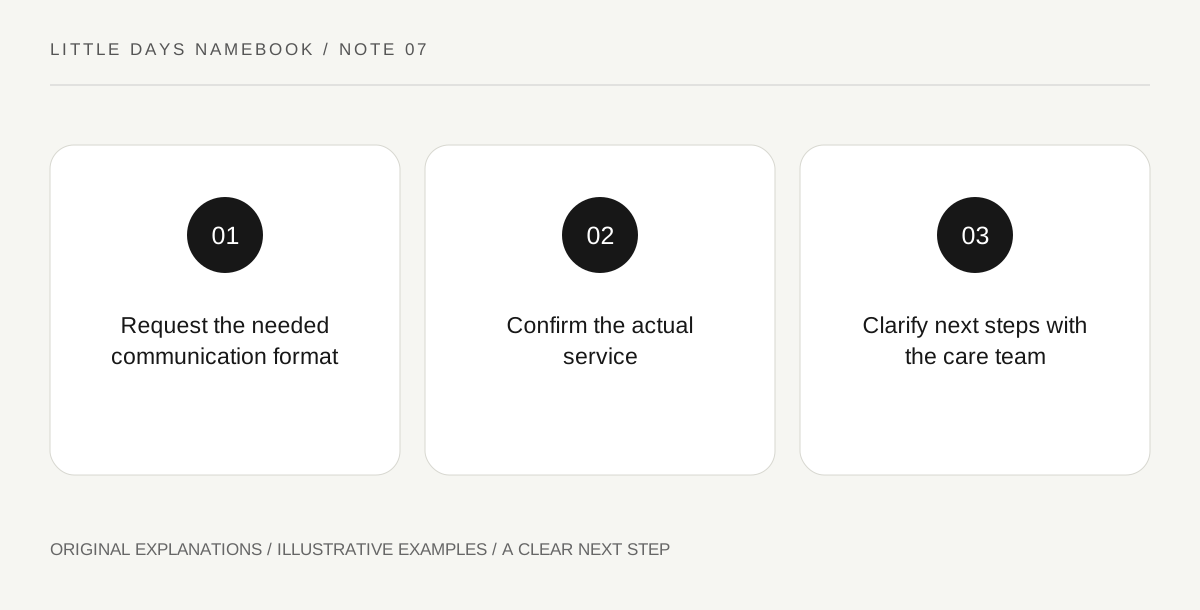
Original explanatory diagram. Read the full method and limitations below.
Describe the communication need
HHS guidance on working with interpreters emphasizes accurate communication, privacy and opportunities to clarify understanding. Use those principles to prepare a service request rather than making assumptions from nationality or the language of an online form. State the language or communication format in which the responsible caregiver can discuss care most comfortably. Reading appointment instructions in one language does not necessarily mean that spoken clinical details are equally clear. Ask the clinic which information it needs to arrange its actual support.
Confirm the arrangement privately
Use the clinic’s appropriate booking route and ask whether support is requested, scheduled or still unresolved. Those are different states. Keep the response with the appointment details and ask what happens if the arrangement changes. This article does not determine legal entitlement or fees in every jurisdiction; the practical task is to obtain the service-specific information from the provider. Do not post private health details publicly to demonstrate why the request matters. A concise description of the communication need is enough to begin the conversation.
Prepare questions that need clear answers
Write a few questions in the caregiver’s preferred language and take them through the clinic’s supported process. During the visit, say when something is unclear and ask for explanation. Do not accept an unfamiliar clinical term simply because everyone appears ready to move on. A companion can provide emotional or practical help in an agreed role, while the clinic explains how interpretation should work. The caregiver should remain part of the conversation rather than being discussed as though they are absent.
Leave with a usable understanding
Ask the care team how to obtain the instructions and follow-up information in a form the caregiver can use. Rephrase the next steps through the supported communication process and clarify anything that remains uncertain. This is a way to improve understanding, not a memory examination for a tired parent. If a question arises afterward, use the clinic’s contact route rather than asking relatives to translate a treatment decision from fragments. The result should be a clearer care conversation with professional responsibility left in the right place.
Illustrative family example
Illustrative request: a caregiver can navigate the appointment website but wants language support for clinical discussion. They ask the clinic before the visit, distinguish a requested service from a confirmed one and bring a short question list. At the end, they clarify the actual next steps through the supported process. A relative helps with transport rather than being assumed to replace the clinic’s interpreting arrangement.
Questions that come up
Does being able to read the website mean interpretation is unnecessary?
Not necessarily. Written booking tasks and spoken clinical discussion can place different demands on a person. Describe the actual need to the provider.
Does this article establish a universal legal right or fee rule?
No. It organizes a provider conversation. Jurisdiction and service rules require their own current authoritative information.
References and scope
These sources support the factual background. Examples and exercises are original illustrative teaching material. References do not imply endorsement.
- HHS Think Cultural Health: Working Effectively with an Interpreter — Accurate interpreted communication, privacy and clarification; no jurisdiction-wide legal or fee claim.